Follow Me On Social Media!

Leftover mashed potatoes are the side dish that outlives the meal. You make them for a roast, everyone takes a spoonful, and the next morning there is a bowl of them in the fridge, cold, stiff, and faintly unappetising — and far too good to throw away. What mashed potatoes want is to be cooked again, into a dish where their softness is an advantage rather than a flaw. The bowl in your fridge can do all of those, and this roundup gives it five jobs.
Five ideas follow, and they are deliberately different from one another: one is fried, one is baked over a filling, one is stirred into soup, one is rolled into pasta, and one is cooked in a waffle iron. The section before them explains how the mash you have decides the dish you should make, and the section at the end gives the storage numbers — the 3-to-4-day rule, and how to freeze the mash if there is too much of it to use this week. For the freezing detail itself, our guide on can you freeze mashed potatoes covers it properly, and it is linked again at the end of this article rather than repeated here.
Which Mash Works for Which Idea
Before choosing an idea, look at the mash you have. Cold mashed potatoes change as they sit in the fridge, and the change decides what they are good for. Mash that was made with plenty of butter and milk is soft and loose even when cold, and it is best for the soup and for the shepherd’s pie topping, because those dishes want mash that spreads easily and melts into what it sits on. Mash that was made leaner — less butter, less milk — firms up in the fridge into a stiff block, and that stiffness is exactly what the potato cakes and the gnocchi need, because both of them need mash that holds a shape without falling apart.

The safest test is the spoon test: if the cold mash slides off a spoon, it is loose mash, and it belongs in a soup or under a grill. If it holds its shape on a spoon and can be sliced with a knife, it is stiff mash, and it belongs in a pan or a pasta dough.
1. Crispy Potato Cakes
Potato cakes are the first idea for a reason: they are the fastest, the most forgiving, and the best use of stiff, cold mash. The method is simple, and our full recipe — how to make crispy pancakes from leftover mashed potatoes — walks through it step by step: take two cups of cold, stiff mash, mix in an egg and a few spoonfuls of flour, season, shape the mixture into patties, and fry them in a little oil in a hot pan until both sides are golden and crisp, about three to four minutes a side.

The secret is that cold mash is better than warm mash. Cold mash holds its shape in the pan, because the butter in it has set and the starch has firmed up; warm mash slumps and spreads, and the cake falls apart before it crisps. The egg binds the mixture, the flour gives it structure, and the hot pan gives it the crust that makes the whole dish work. The inside stays soft and creamy, the outside goes crisp and golden.
2. Shepherd’s Pie or Cottage Pie Topping
A shepherd’s pie is the best use of loose mash, and it is the idea that turns the most leftovers into one dinner. Make a filling in a pan: mince or leftover meat — lamb for a shepherd’s pie, beef for a cottage pie — browned with onion, carrot, and celery, simmered in stock with a spoonful of tomato paste until it is thick and rich. Spoon the filling into a baking dish, spread the leftover mash over the top, and rough up the surface with a fork, because a rough surface browns better than a smooth one. Bake at a hot oven until the filling is bubbling at the edges and the mash is golden on top, about twenty-five to thirty minutes.

The mash is the point here, and the reason it works is that a shepherd’s pie topping wants mash that is soft enough to spread and rich enough to brown. Leftover mash is already seasoned and already buttery, which means the topping is better than a freshly made one would be, and the roughened fork marks catch the heat and crisp into ridges that a smooth topping never gets. This is also the idea that pairs with the other holiday leftovers: leftover turkey makes a good filling, and so does any leftover roast.
3. Creamy Soup Thickener
The third idea is the quietest one: stir the leftover mash into soup. A spoonful or two of mashed potatoes stirred into a thin soup — a chicken soup, a vegetable soup, a leek soup — thickens it, gives it body, and adds a creaminess that no amount of cream can match, because the potato starch thickens without making the soup heavy. Add the mash a spoonful at a time, stirring well, and let it simmer for a few minutes so the starch swells and the soup turns silky. Taste and season at the end, because the mash brings its own salt and butter with it.

Loose mash is the right kind for this, because it dissolves into the soup without lumps; stiff mash will dissolve too, but it needs more stirring and a longer simmer to disappear. This is the best idea for a small amount of leftover mash — a cup or less, too little for a pie and not enough for a batch of cakes — because a soup will happily take it and turn it into something useful. It is also the best idea when the mash is on its last day, because the soup is cooked and eaten the same day.
4. Gnocchi
Gnocchi is the most ambitious idea in the roundup, and it is the one that turns leftover mash into something nobody will recognise as a leftover. The method is old and simple: cold, stiff mash — about two cups — mixed with one egg and enough flour to make a soft dough, rolled into ropes, cut into pieces, and pressed with a fork to make the ridges that hold the sauce. Boil them in salted water until they float to the surface, which takes two or three minutes, and then toss them in butter and sage, a tomato sauce, or a cream sauce, and serve them immediately.
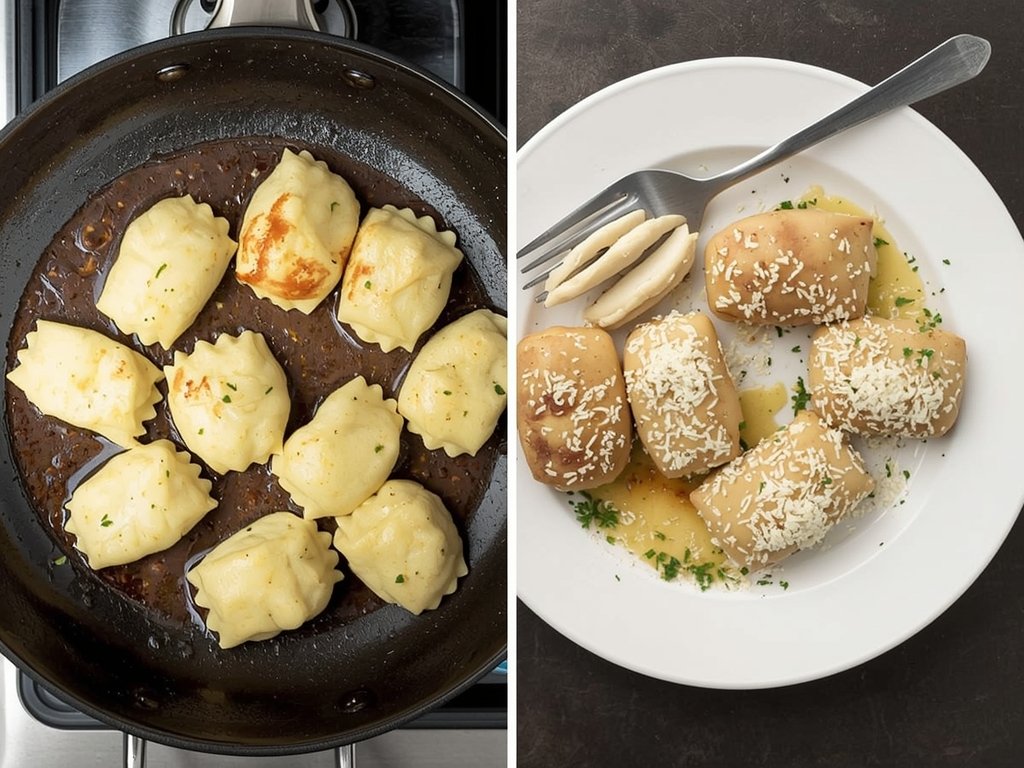
The mash matters here more than anywhere else, because gnocchi made from wet mash needs too much flour, and too much flour makes gnocchi heavy. Stiff, cold mash — the kind that slices cleanly with a knife — is the right starting point, and the less flour you need to make the dough hold together, the lighter the gnocchi will be. Add the flour a spoonful at a time, knead the dough as little as possible, and stop as soon as it holds together. The fork ridges are not decoration: they catch the sauce, and a gnocchi without them holds half as much flavour.
5. Potato Waffles
The last idea is the one that surprises people: cook the mash in a waffle iron. Mix two cups of cold mash with an egg, a handful of grated cheese, and a spoonful or two of flour, season it, and spoon it into a hot, oiled waffle iron. Close the lid and cook for four to five minutes, until the waffle is golden and crisp and releases easily from the iron. What comes out is a potato waffle: crisp ridges on the outside, soft mash on the inside, and the cheese melted into pockets through the whole thing.

The waffle iron does what a frying pan cannot, which is to crisp the mash on both sides at once and in a shape that holds. A potato cake in a pan needs turning and watching; a potato waffle in an iron needs nothing until it is done, and the ridges give it a surface area that a flat cake never has. The mixture should be thick enough to hold its shape in the iron but loose enough to spread a little when the lid closes. If it is too stiff, add a splash of milk; if it is too loose, add another spoonful of flour.
Beyond the Five Ideas: More Ways to Use Mashed Potatoes
The pattern across all five ideas is the one set out at the start: stiff, cold mash for the cakes, the gnocchi, and the waffles; loose mash for the shepherd’s pie and the soup. But there is a sixth use that sits outside this roundup and is worth knowing about: mashed potato in bread. Our leftover mashed potato focaccia uses the mash in a bread dough, where the potato starch keeps the crumb soft for days — and it is the idea to pick if you like baking and you have mash that is too loose for cakes and too little for a pie.

The wider lesson is that mashed potatoes are a raw material, not a finished dish, and the fridge bowl is worth more than the side it came from. A spoonful in soup, a batch of cakes, a pie topping, a plate of gnocchi, or a waffle: each of them is a real meal, and none of them tastes like a leftover.
How Long Leftover Mashed Potatoes Keep (and How to Freeze Them)
The storage rule is the standard leftover rule. Cooked mashed potatoes keep 3 to 4 days in the fridge, according to the USDA’s leftovers and food safety guidance, and they should be reheated to 165°F, measured with a food thermometer. The FoodSafety.gov cold food storage chart gives the same 3-to-4-day fridge window for cooked leftovers generally. Cool the mash quickly — spread it in a shallow container rather than leaving it in a deep bowl — refrigerate it within 2 hours of cooking, and throw it away if it has sat out longer than that, or if it smells off, looks slimy, or has been in the fridge past the 3-to-4-day window. Do not reheat the same portion more than once.
Freezing is the answer when there is too much mash to use in four days. The USDA’s leftovers guidance puts frozen leftovers at 3 to 4 months of best quality, and that figure is the one to use for frozen mash: it stays safe indefinitely at 0°F, but the texture declines after a few months, and the flavour flattens. The Kitchn, the food publication, recommends freezing mashed potatoes for within a month for the best texture — a shorter, stricter window than the USDA’s, and the one to follow if texture matters more than storage time.
The full method matters more than the number, and it is not repeated at length here because our guide on can you freeze mashed potatoes covers it: freeze the mash in shallow containers or bags while it is still fresh, leave headspace, label it with the date, and thaw it in the fridge overnight. To reheat it so it stays creamy — which is a separate skill, because reheated mash goes dry and gluey if it is handled wrong — the guide on how to reheat mashed potatoes so they stay creamy covers the butter, the milk, and the gentle heat that brings it back. That window is the planning rule for all five ideas: cook the mash, keep it cold and covered, use it within three or four days — or freeze it on day one and choose the dish later.

Ghani is the founder of TwiceTasty and a passionate home cook who believes no meal should go to waste. What started as a personal mission to transform leftovers into exciting new dishes has grown into a community of food lovers who share the same philosophy.

← Previous
What to Do With Leftover Ham: 7 Ideas (Beyond the Sandwich)
Next →
What to Do With Leftover Stuffing: 7 Ideas