Follow Me On Social Media!

1. The Breakfast Betrayal We’ve All Suffered

It’s Sunday morning. You’re craving something warm and comforting. You pull that bag of frozen biscuits from the freezer—maybe they’re homemade leftovers you carefully wrapped, or perhaps that tempting store-bought variety from the grocery aisle. You follow the package instructions, pop them in the microwave, and wait with hope.
Dense. Rubber-y. Disappointing.
The outside is weirdly tough while the inside remains oddly cold in spots. The buttery layers you remember? Gone. Compressed into a uniform, chewy mass that tastes like regret. You slather on butter and jam trying to save it, but you know the truth: you’ve committed biscuit homicide.

Here’s what most people don’t realize: frozen biscuits are actually fragile architectural marvels. Those flaky layers depend on butter staying cold until baking, creating steam pockets that puff upward. The microwave steam-cooks them from the inside, collapsing that delicate structure before the outside ever gets crispy. It’s like trying to revive a croissant with a steam bath—it just doesn’t work.
But there’s a better way. A method that turns frozen biscuits into something that rivals fresh-baked. At TwiceTasty, we’ve air-fried hundreds of biscuits (homemade, store-bought, jumbo, mini—you name it) to find the perfect technique.
The TwiceTasty Secret? Low-temp thawing followed by a high-heat crisp finish in the air fryer. This two-stage approach preserves the layered interior while creating that crave-worthy golden exterior. Let’s break down exactly how to nail it.
2. The Science of Frozen Biscuit Revival

Before we fire up the air fryer, let’s understand why biscuits are particularly tricky to reheat—and why the air fryer is actually perfect for the job.
Why Biscuits Turn Into Bricks
Butter Solidification: Biscuit dough relies on cold butter chunks layered between flour. When frozen, that butter becomes rock-hard. Reheat too fast, and the outside burns before the inside butter melts and creates steam. Reheat too slow with moisture (microwave), and you get a steamed dumpling texture instead of flaky layers.
Starch Retrogradation: As biscuits cool and freeze, the starch molecules recrystallize, making them tough. This is why day-old biscuits feel like hockey pucks. You need heat to break those crystals back down—but controlled heat.
Moisture Migration: Freezing creates ice crystals within the dough. When reheated improperly, these melt unevenly, creating soggy spots or dry zones. The goal is even, gentle thawing followed by rapid moisture evaporation from the surface.
Why Air Fryers Are Biscuit Heroes

Air fryers excel here because of circulating dry heat and precise temperature control. Here’s the science:
- Convection airflow wicks away surface moisture as the biscuit thaws, preventing sogginess
- Temperature precision lets you start low (gentle thawing) then finish high (Maillard reaction for golden crust)
- Rapid heat transfer means the butter melts quickly and evenly, creating steam that puffs layers without collapsing them
Think of it as mimicking a bakery oven’s convection setting—but faster and more controlled. The result? A biscuit that’s crispy outside, fluffy and layered inside, with actual butter flavor instead of that weird “warmed-over” taste.
3. The TwiceTasty Method: Perfect Air Fryer Biscuits Every Time
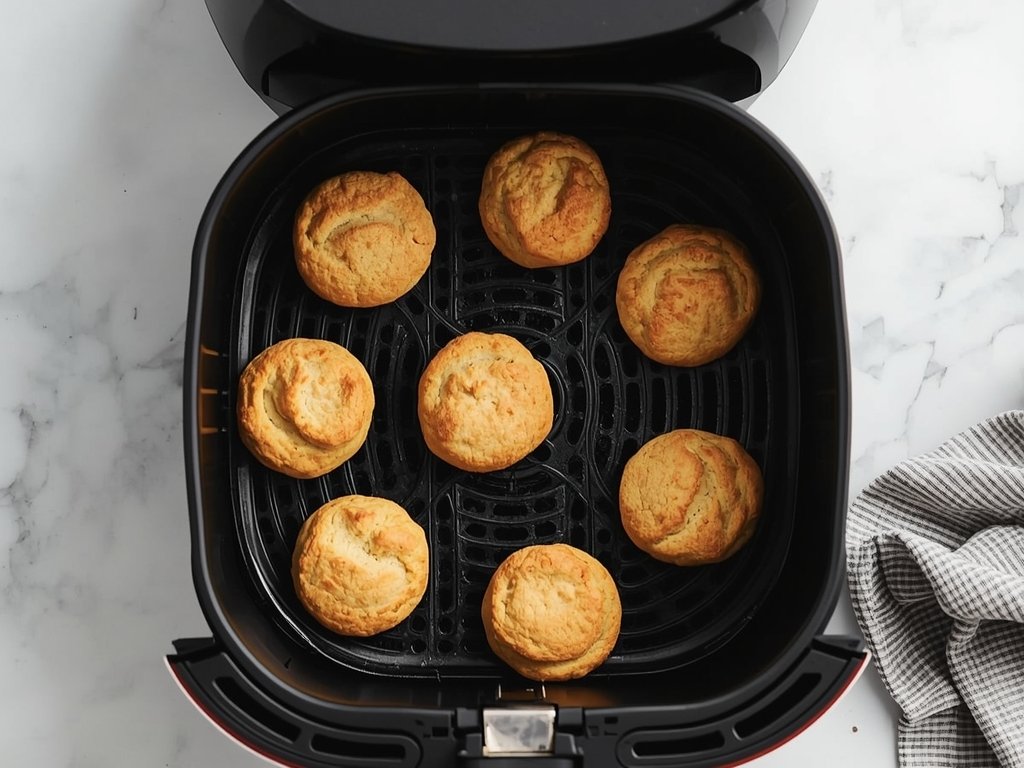
This is the technique we perfected after dozens of tests. Follow these numbers exactly—biscuits are less forgiving than tacos when it comes to temperature precision.
For Standard Frozen Biscuits (Homemade or Store-Bought, 2-3 inch diameter)
Step 1: Prep the Basket Place frozen biscuits in the air fryer basket with 1-2 inches of space between each one. Air circulation is critical—crowding creates steam pockets that ruin the crust. If your biscuits are touching, work in batches.
Pro Tip: If biscuits are stuck together from the freezer, don’t force them apart while frozen. They’ll break. Air fry for 2 minutes at low temp first, then gently separate.
Step 2: The Gentle Thaw (Low Heat Stage) Set air fryer to 300°F (150°C) and cook for 5 minutes. This slowly brings the interior temperature up without shocking the butter or burning the outside. The biscuits will soften but won’t brown yet.
Step 3: The Fluff Phase (Medium Heat) Increase temperature to 325°F (165°C) and continue for 3-4 minutes. The layers begin to separate here, and the biscuit starts rising. You should see visible height increase.
Pro Tip: If your air fryer runs hot (common in smaller models), check at 2 minutes. You’re looking for pale golden color, not brown.
Step 4: The Golden Finish (High Heat) Bump to 375°F (190°C) for final 2-3 minutes until deep golden brown. This creates the crispy exterior while the interior finishes setting. Total time: 10-12 minutes.
Step 5: The Crucial Rest Remove biscuits immediately and let rest on a wire rack (not a plate) for 2 minutes. This allows steam to escape without making the bottom soggy. The carryover heat finishes the interior.
For Large/Grands-Style Frozen Biscuits (3.5+ inch diameter)
Step 1: Space generously—only 2-3 per basket max.
Step 2: Thaw Stage: 300°F for 7 minutes (larger mass needs more time).
Step 3: Fluff Phase: 325°F for 4-5 minutes.
Step 4: Golden Finish: 375°F for 3-4 minutes. Total time: 14-16 minutes.
Pro Tip: For extra-large biscuits, insert a toothpick in the center during the rest phase. It should come out clean with no wet dough attached. If not, return to 325°F for 2 more minutes.

For Mini Frozen Biscuits (1-1.5 inch diameter)
Step 2: Thaw Stage: 300°F for 3 minutes.
Step 3: Fluff Phase: 325°F for 2 minutes.
Step 4: Golden Finish: 375°F for 1-2 minutes. Total time: 6-7 minutes.
Pro Tip: Mini biscuits go from perfect to burnt fast. Check the golden finish at 90 seconds.
4. Flavor Boosters & Next-Level Variations
Sometimes you want pure biscuit perfection. Other times? You’re feeling creative. These quick upgrades transform reheated frozen biscuits into something that tastes bakery-fresh.
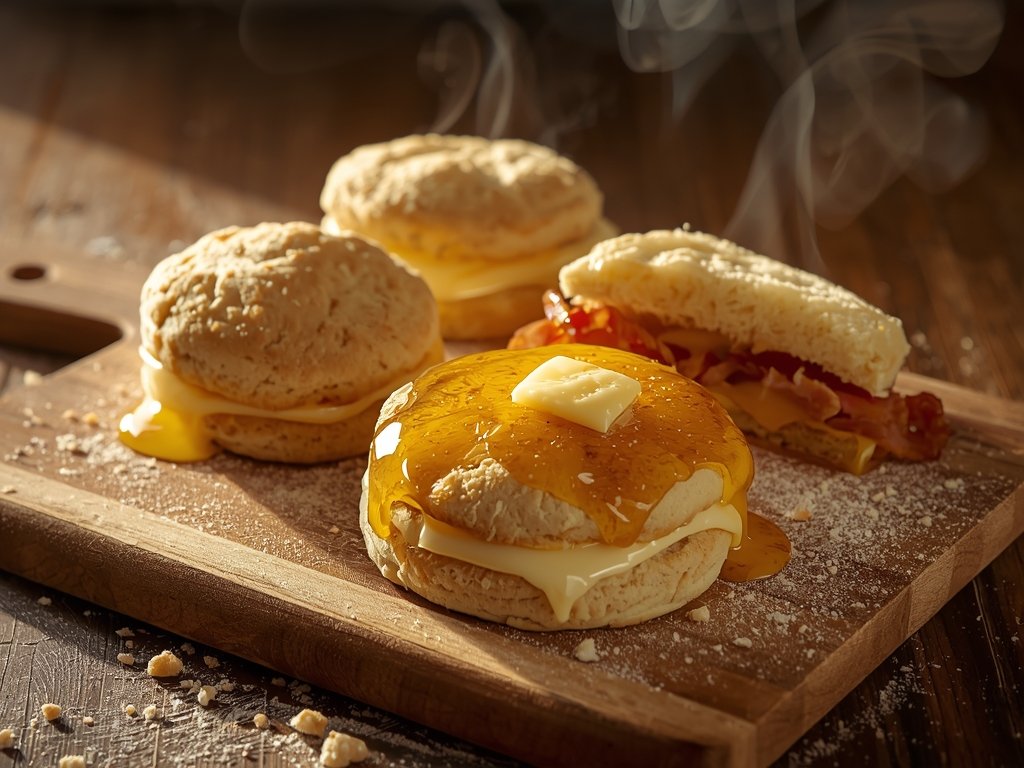
The Butter Bath Technique
During the final 2 minutes of cooking, brush the tops with melted butter mixed with a pinch of garlic powder and dried parsley. The air fryer crisps this into a flavorful, savory crust that masks any “frozen” taste.
Time added: 30 seconds.
The Sweet Glaze Finish
For a breakfast treat, mix 2 tablespoons melted butter with 1 tablespoon honey and a dash of cinnamon. Brush on during the last minute of high-heat cooking. Creates a sticky, slightly caramelized top that’s incredible with coffee.
Time added: 1 minute.
The Biscuit Sandwich Hack
Split the biscuit immediately after the rest phase while still warm. Add a slice of cheese and leftover bacon or sausage, then return to the air fryer for 1 minute at 350°F. The cheese melts into the layers, and you get a hot breakfast sandwich with actual structural integrity.
Pro Tip: Use a toothpick to hold the sandwich closed during the final melt—it prevents the top from sliding off.
5. Food Safety & Storage: Keeping Biscuits Freezer-Ready
Biscuits are generally safe, but improper storage before freezing can ruin your reheating results—or make you sick.
Freezing Homemade Biscuits Right

Cool completely first: Never freeze warm biscuits. Trapped steam creates ice crystals that destroy texture.
Wrap individually: Use plastic wrap, then foil, then place in a freezer bag. Double-wrapping prevents freezer burn that creates off-flavors.
Storage time: Properly wrapped homemade frozen biscuits last 2-3 months maximum. Store-bought frozen biscuits follow package dates—usually 6-8 months unopened.
The Thawing Danger Zone
Never thaw biscuits on the counter overnight. The outer layers reach unsafe temperatures (40-140°F) while the center stays frozen. Bacteria love this scenario.
Safe thawing options:
- In the refrigerator overnight (best for planning ahead)
- Directly in the air fryer using our method above (safest and tastiest)
- In the microwave only if eating immediately (texture sacrifice)
Storage Safety Checklist
- Do label homemade frozen biscuits with the date. After 3 months, quality degrades significantly.
- Do check store-bought bags for ice crystals or freezer burn before buying—damaged packaging means compromised biscuits.
- Don’t refreeze thawed biscuits. The texture becomes irreversibly tough, and bacteria risk increases.
- Don’t store opened bags of frozen biscuits for more than 1 month. The freezer burn sets in fast once exposed to air.
6. FAQ: Your Biscuit Reheating Questions Solved

Can I put frozen biscuits directly in the air fryer without thawing first?
Absolutely—that’s actually the preferred method. Thawing on the counter creates texture issues and food safety risks. The air fryer handles thawing and reheating simultaneously when you follow our staged temperature method. Direct-to-air-fryer is the TwiceTasty way.
Why are my air fryer biscuits burning on top but doughy in the middle?
Your air fryer is too hot or the biscuits are too large for the rapid airflow. Lower the temperature by 25°F and extend cooking time. Large biscuits need the gentler thaw stage we outlined. If the top browns too fast, loosely cover with foil during the middle phase.
Can I reheat already-baked refrigerated biscuits in the air fryer?
Yes, but the method changes. For refrigerated (not frozen) biscuits: 325°F for 3-4 minutes total is usually perfect. They don’t need the thaw stage. Watch for over-browning—they’re already cooked, you’re just refreshing them.
My biscuits are still frozen in the center after following the times. What happened?
Either your air fryer runs cool (common in larger models) or the biscuits were extra-thick. Add 2 minutes to the 300°F thaw stage next time. Every air fryer varies—learn yours and adjust. The toothpick test (clean insertion) is your best friend
Can I make biscuit gravy while they air fry?
Smart planning! Biscuits and gravy are a perfect pair. Start your sausage gravy when you begin the air fryer’s high-heat phase (step 4). Everything finishes simultaneously for maximum warmth.
Your Biscuits Deserve Better Than the Microwave

Frozen biscuits don’t have to be a breakfast consolation prize. With the right technique—low and slow thawing, then high-heat crisping—you can achieve that fresh-baked texture that makes weekend mornings feel special. The air fryer isn’t just a convenience tool here; it’s actually the best possible appliance for the job.
Remember: space them out, stage your temperatures, and let them rest. Those three principles separate sad, dense biscuits from tall, flaky perfection.
What’s your go-to biscuit topping? Are you a butter-and-honey purist, or do you go full Southern with sausage gravy? Drop your favorite combo below—and tell me if you’ve tried any wild biscuit variations (I’ve seen everything from Nutella-stuffed to fried chicken biscuits). Let’s build the ultimate biscuit inspiration board together.
Happy air frying, and may your layers always be flaky.

Marco covers the Reheat Pro category on TwiceTasty, focusing on reheating techniques and texture preservation. His articles help home cooks bring leftovers back to life with the right methods for every type of food — from crispy fried chicken to creamy pastas.

← Previous
Master Tandoori-Style Naan Char at Home
Next →
Here’s How to Reheat Wingstop Wings for Maximum Flavor